PRODUCT TOUR

The console, clickable.

The three jobs of whoever patches the PCs: know what is installed, roll out updates without breaking anyone, and show what ran. Walk them in the browser, nearly every page and setting, or skim the seven screens below.

Best on a laptop-sized screen; on a phone it opens at desktop width, so zoom in.

What you are looking at. Community Edition v26.11.1100, running in an isolated stack, then saved page by page. The company, its 100 PCs, its users and the events those PCs report are made up. The apps are real, and so are their installers, signing certificates, sandbox runs and SBOMs: they come from an Attestree install we run ourselves. The CVE records are the full CVE list (cvelistV5) and CISA’s known-exploited list as fetched on the capture day, matched by the platform itself against the made-up inventory. Everything the demo shows Attestree signing was signed by the stack while it ran: the audit trail, the operator’s consents and each version’s statement. The demo is read-only, so actions are switched off. No customer environment appears here.

A company of about 100 PCs. The machines are made up; the apps, their tests and their results are real, from an Attestree install we run ourselves.

01 · Know what is installed

Every app on every PC, whatever installed it.

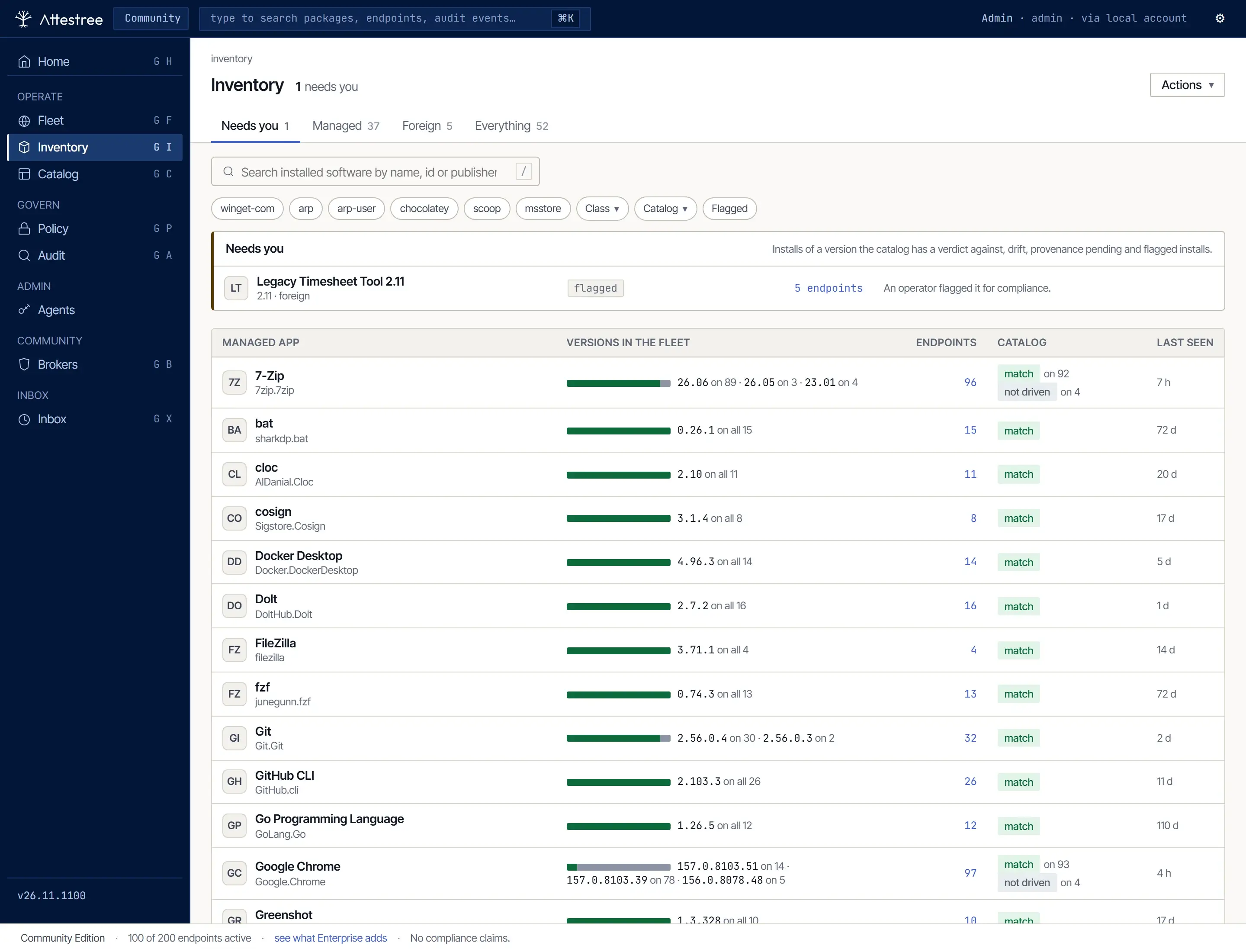
One list for the company’s 100 PCs, whatever put the app there: winget, Chocolatey, Scoop, the Microsoft Store or a plain Add/Remove Programs entry. It opens on what needs a decision, here an old timesheet tool someone flagged on five PCs. Below it, every app Attestree manages, with the versions the fleet runs and how each copy got there: “match” where Attestree installed it, “not driven” where something else did, as on four PCs set up from an old image.
attestree console · /inventory
The Inventory page, with tabs for Needs you (1), Managed (37), Foreign (5) and Everything (52), a search box, and filter chips for winget-com, arp, arp-user, chocolatey, scoop and msstore. The needs-you list shows Legacy Timesheet Tool 2.11, flagged, on 5 endpoints. Below, a managed-app table: 7-Zip with 26.06 on 89, 26.05 on 3 and 23.01 on 4, reading match on 92 and not driven on 4; bat, cloc, cosign, Docker Desktop, Dolt, FileZilla, fzf, GitHub CLI and Go, each on one version, and Git with 2.56.0.4 on 30 and 2.56.0.3 on 2, all reading match; and Google Chrome with 157.0.8103.51 on 14, 157.0.8103.39 on 78 and 156.0.8078.48 on 5, reading match on 93 and not driven on 4.

Scroll the frame sideways to read it.

Open this page in the demo
02 · Update safely

A new version is tested before any PC gets it.

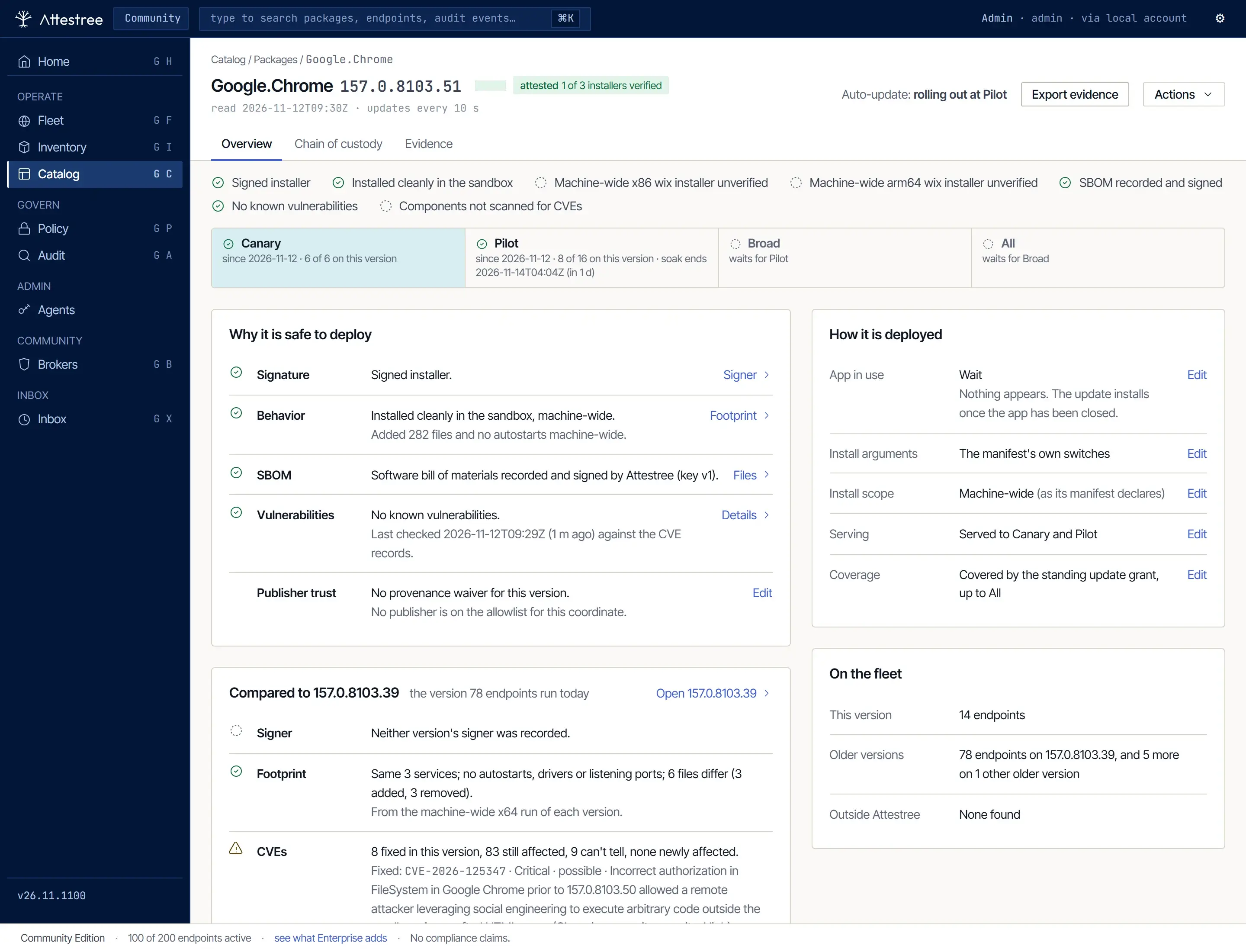
Chrome 157.0.8103.51 was installed in a throwaway VM first, and this page is the result: a record of what ran, not a promise. The capture is from 26.11.1100, whose heading called it safe to deploy; since 26.11.1300 the console reads “Passed its checks”. It leads with what the test found: a signed installer, a clean install, an SBOM, no known vulnerabilities. Two of Chrome’s three installers, for x86 and arm64, were not tested, and the page says so. “No known vulnerabilities” counts confirmed matches only. Lower down, the comparison with 157.0.8103.39 lists 83 possible ones, all fixed in a later Chrome, 157.0.8103.78. Then the rings: canary has it on all 6 PCs, pilot on 8 of 16 so far, and broad and all wait their turn.
attestree console · /catalog/pkg/Google.Chrome/157.0.8103.51
The Google.Chrome 157.0.8103.51 page, labelled attested, 1 of 3 installers verified, with Auto-update: rolling out at Pilot. A strip of checks reads signed installer, installed cleanly in the sandbox, machine-wide x86 and arm64 wix installers unverified, SBOM recorded and signed, no known vulnerabilities, and components not scanned for CVEs. Four ring cells follow: Canary, since 2026-11-12, 6 of 6 on this version; Pilot, 8 of 16 on this version, soak ends in 1 day; Broad waits for Pilot; All waits for Broad. Below, a card headed Why it is safe to deploy lists the signature, the behavior (installed cleanly machine-wide, 282 files added, no autostarts), the SBOM and the vulnerabilities; beside it, how the version is deployed and how many endpoints run it; and a comparison with 157.0.8103.39, the version 78 endpoints run today, whose CVE row reads 8 fixed in this version, 83 still affected, 9 can’t tell, none newly affected.

Scroll the frame sideways to read it.

Open this page in the demo
03 · Update safely

Then it goes out ring by ring.

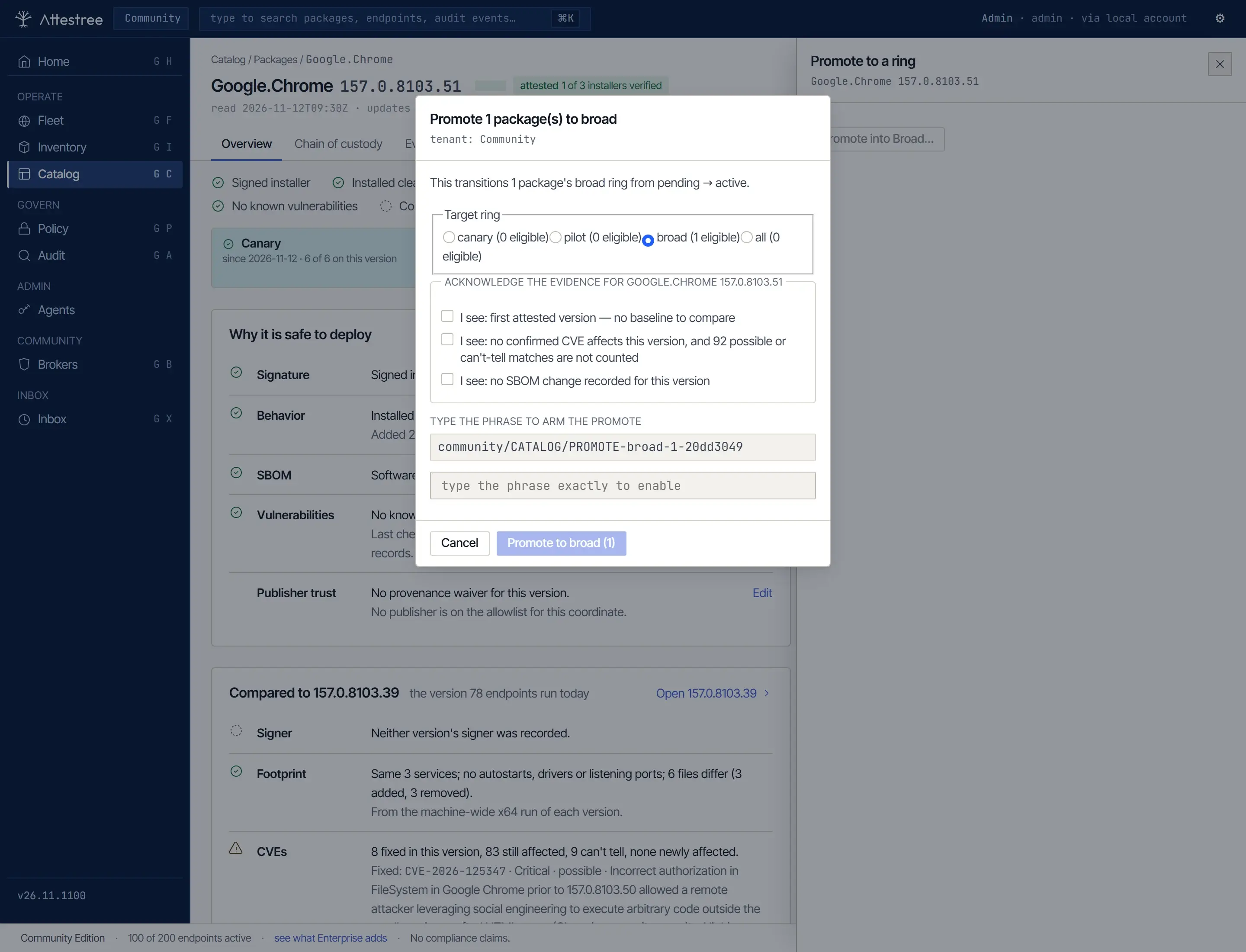
The next ring is one step from the same page, and the console makes it a deliberate one. The form names the target ring, asks you to tick what the evidence says (here, that no confirmed CVE affects the version and that the possible matches are not counted), then to type the phrase it shows. This is the form as the console draws it, with nothing typed, so its final button stays off.
attestree console · /catalog/pkg/Google.Chrome/157.0.8103.51 · Promote
The Chrome 157.0.8103.51 page, dimmed behind a dialog titled Promote 1 package(s) to broad, tenant Community. It says this moves the package’s broad ring from pending to active. Target ring buttons: canary, pilot and all with 0 eligible, and broad with 1, selected. Under Acknowledge the evidence for Google.Chrome 157.0.8103.51, three unticked boxes: first attested version, no baseline to compare; no confirmed CVE affects this version, and 92 possible or can’t-tell matches are not counted; no SBOM change recorded for this version. Then the phrase to type, starting community/CATALOG/PROMOTE-broad-1, an empty field for it, a Cancel button and a switched-off Promote to broad (1) button.

Scroll the frame sideways to read it.

Open this page in the demo
04 · Update safely

It stops on its own when the publisher changes.

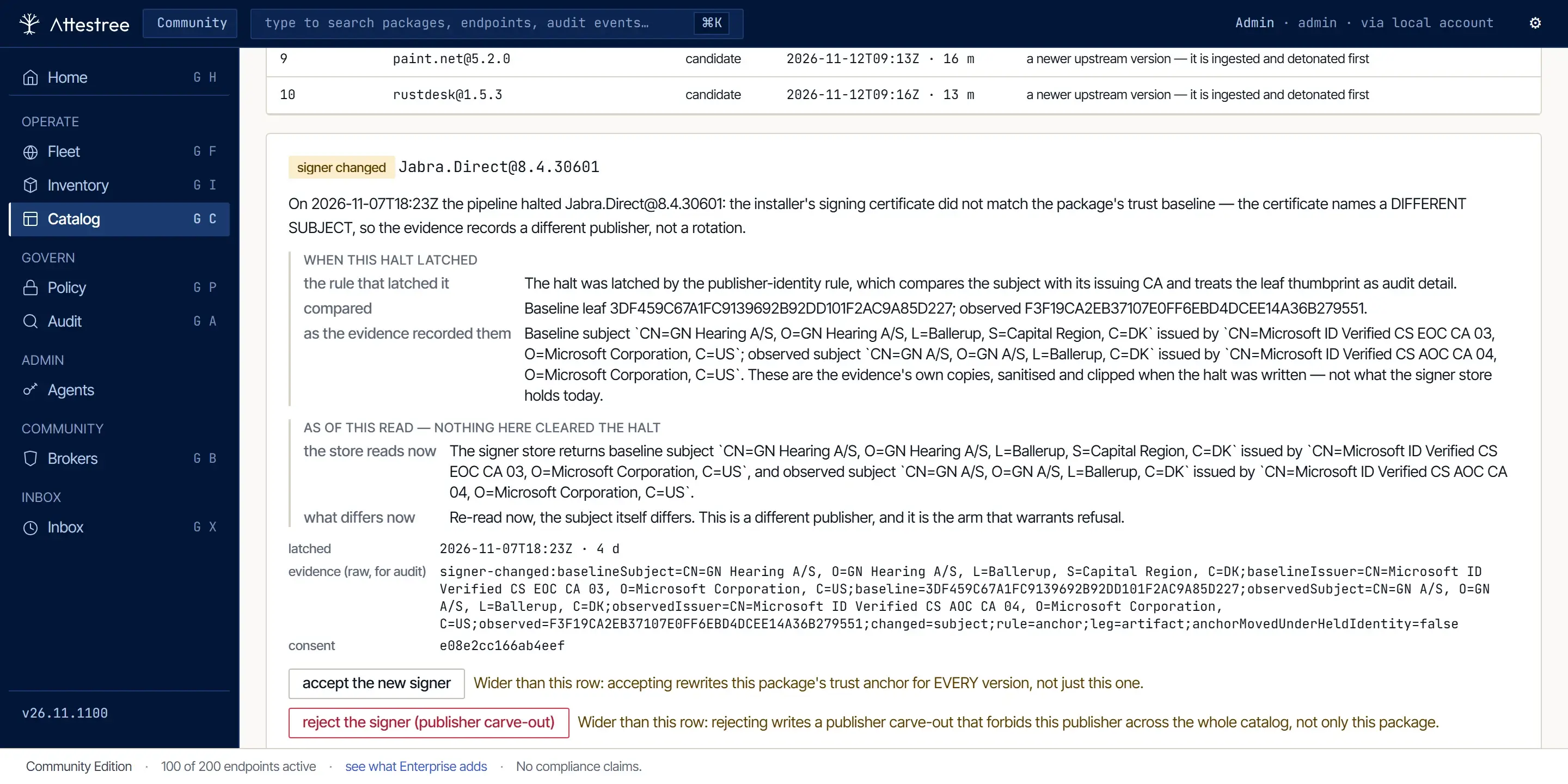
Jabra Direct 8.4.30601 arrived with an installer signed by GN A/S, through another of Microsoft’s certificate authorities; 8.3.26701’s was signed by GN Hearing A/S. A new name on the certificate reads as a new publisher, so the pipeline stopped the update, and it waits for a person to accept the new signer or reject it. Both certificates were read from Jabra’s own installers. The card does not say why the name changed, and neither do we.
attestree console · /catalog/update-pipeline/halts
A halt card tagged signer changed for Jabra.Direct@8.4.30601. It says the pipeline halted the version because the installer’s signing certificate did not match the package’s trust baseline: the certificate names a different subject, so the evidence records a different publisher, not a rotation. It lists the two certificates: the baseline, subject GN Hearing A/S, issued by Microsoft ID Verified CS EOC CA 03, and the observed one, subject GN A/S, issued by Microsoft ID Verified CS AOC CA 04, with both leaf thumbprints. Two buttons end the card: accept the new signer, noted as rewriting the package’s trust anchor for every version, and reject the signer (publisher carve-out), noted as forbidding the publisher across the whole catalog.

Scroll the frame sideways to read it.

Open this page in the demo
05 · Update safely

And it rolls back.

Edge 156.0.4314.58 runs on canary and pilot, and the version before it, 156.0.4314.50, is kept ready on both. If the new one misbehaves, one confirmed step returns a ring to it: here the pilot ring, behind its own typed phrase, with the final button off as before.
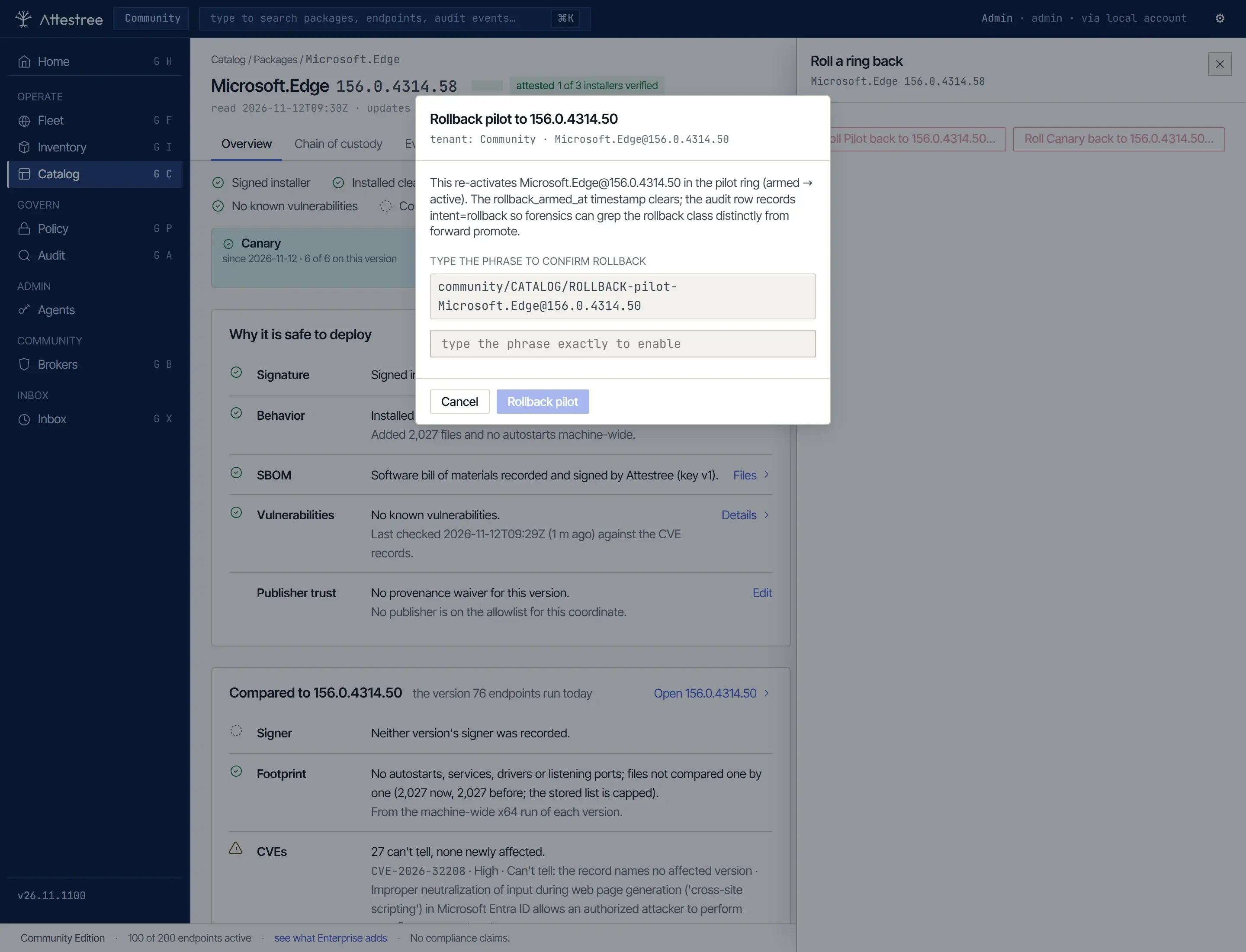
attestree console · /catalog/pkg/Microsoft.Edge/156.0.4314.58 · Roll back
The Microsoft.Edge 156.0.4314.58 page, dimmed behind a dialog titled Rollback pilot to 156.0.4314.50, tenant Community. It says this re-activates Microsoft.Edge 156.0.4314.50 in the pilot ring, from armed to active, and that the audit row records it as a rollback. Then the phrase to type, community/CATALOG/ROLLBACK-pilot-Microsoft.Edge@156.0.4314.50, an empty field for it, a Cancel button and a switched-off Rollback pilot button. Behind the dialog, a drawer titled Roll a ring back offers Roll Pilot back and Roll Canary back to 156.0.4314.50.

Scroll the frame sideways to read it.

Open this page in the demo
06 · Know what is installed

When a CVE lands, you see who is exposed.

CVE-2026-48095, rated high, names 7-Zip up to 26.00. Filtered to the PCs still exposed, its page lists four Operations PCs on 23.01: they were set up from an old image, and Attestree did not install their 7-Zip. The fixed version, 26.06, is live in canary, pilot and broad, and the all ring waits behind a button that deploys it there. The CVE records are the full CVE list and CISA’s known-exploited list as fetched on the capture day, matched by the platform itself.
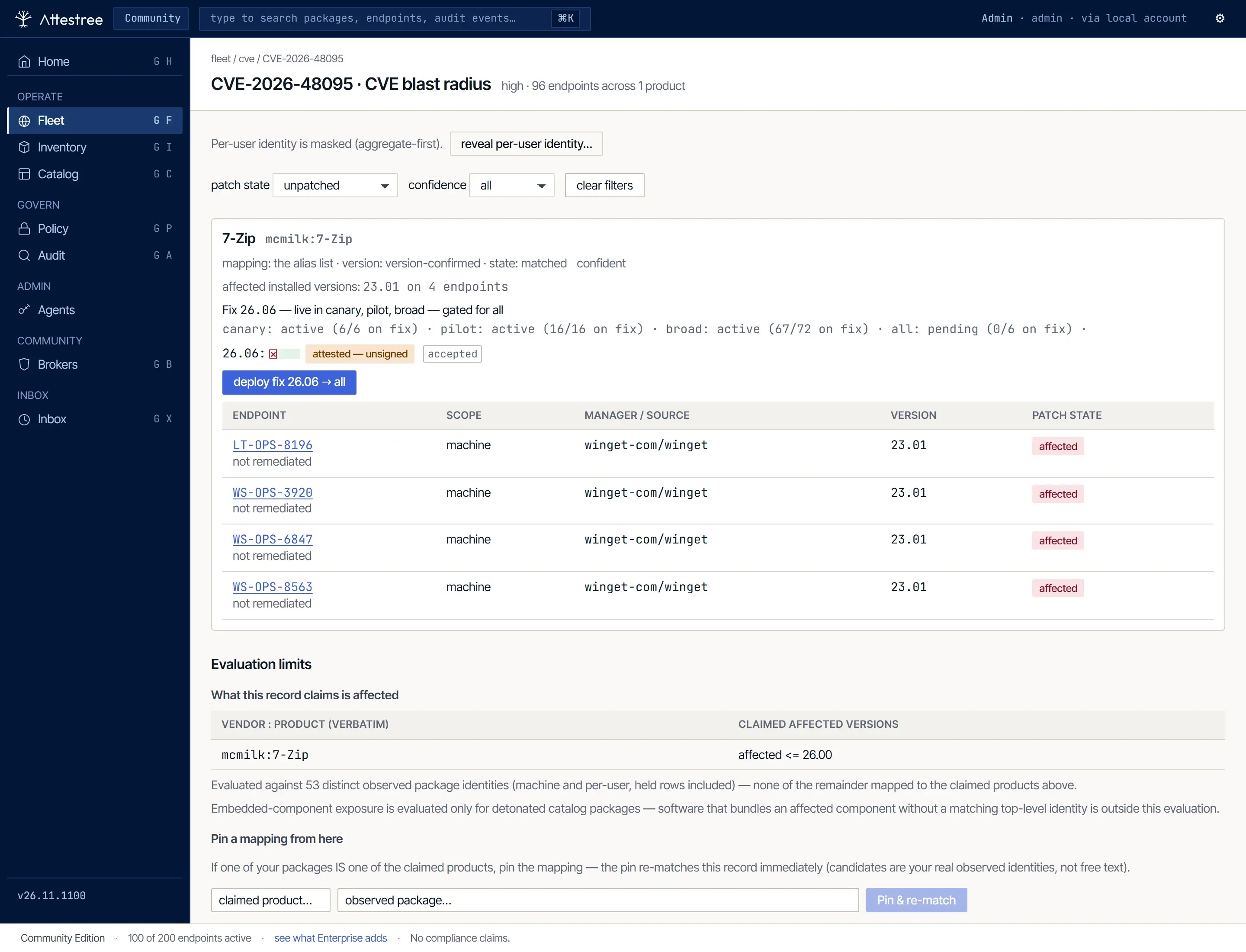
attestree console · /fleet/cve/CVE-2026-48095
The blast-radius page of CVE-2026-48095, rated high, 96 endpoints across 1 product, filtered to the unpatched patch state. The 7-Zip card reads version-confirmed and confident, affected installed versions 23.01 on 4 endpoints, and fix 26.06, live in canary, pilot and broad and gated for all, with 6 of 6, 16 of 16, 67 of 72 and 0 of 6 endpoints on it, attested and unsigned, with an acceptance, and a deploy fix 26.06 → all button. Its table lists LT-OPS-8196, WS-OPS-3920, WS-OPS-6847 and WS-OPS-8563, each machine scope, winget, on 23.01, not remediated and affected. Below, the record’s own claim: mcmilk:7-Zip affected up to 26.00.

Scroll the frame sideways to read it.

Open this page in the demo
07 · Show what ran

Keep the receipt.

Each tested version gets a statement signed by your own install’s key, naming the installer by the SHA-256 its winget manifest declares, the package, and the sandbox run behind it. That signed statement is the attestation, in the in-toto format. Beside it are the SBOM, Syft’s list of the components in the installed files, the key set, and the command that checks them offline with wep-bundle-verify, without trusting this page. A check proves which key signed, not that the run was honest.
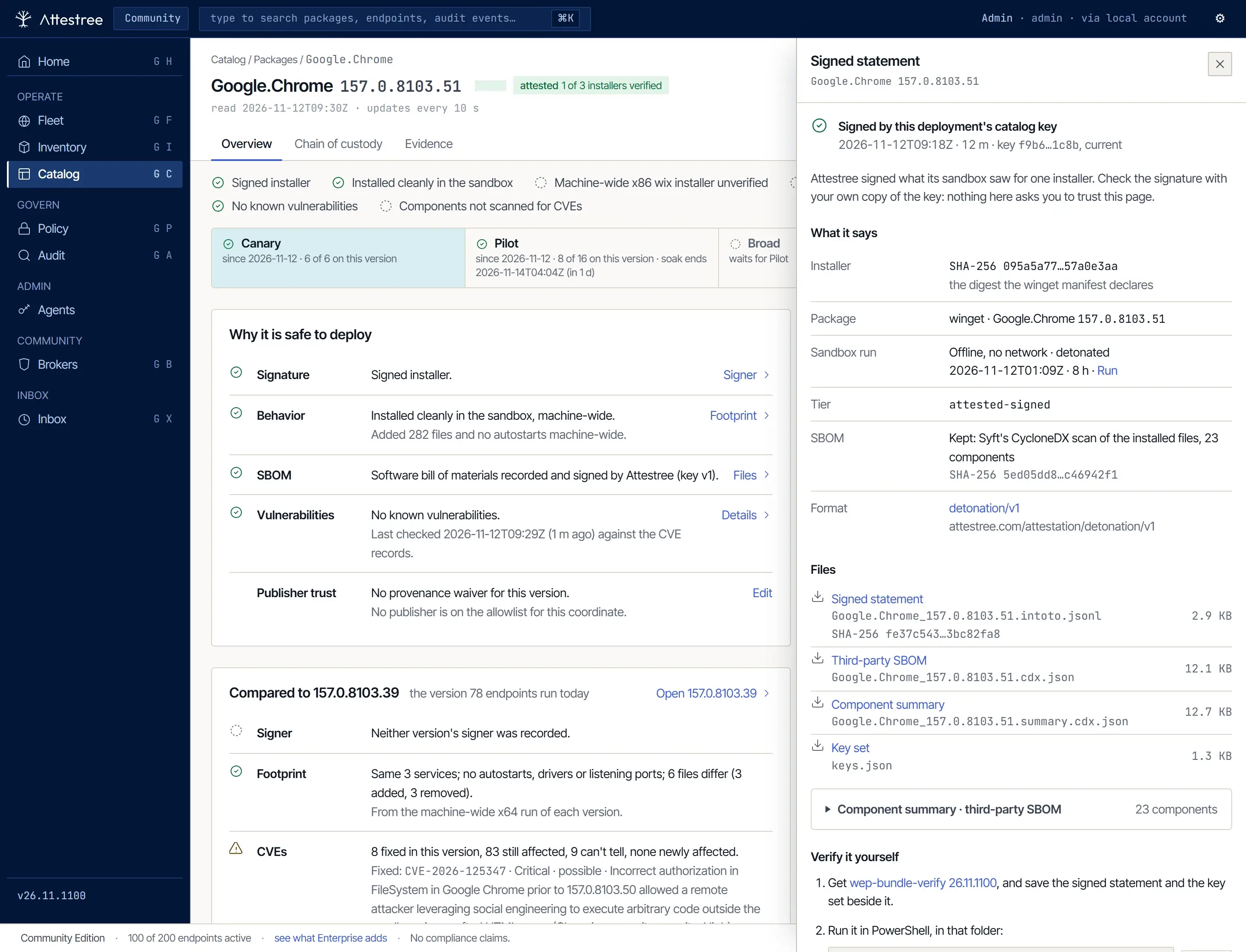
attestree console · /catalog/pkg/Google.Chrome/157.0.8103.51 · Signed statement
The Chrome 157.0.8103.51 page with its Signed statement drawer open. The drawer reads signed by this deployment’s catalog key, current, and says Attestree signed what its sandbox saw for one installer, to be checked with your own copy of the key. What it says: the installer’s SHA-256, the digest the winget manifest declares; the package, winget Google.Chrome 157.0.8103.51; the sandbox run, offline with no network; the tier, attested-signed; the SBOM kept, Syft’s CycloneDX scan of the installed files with 23 components; and the format, detonation/v1. Files to download: the signed statement, the third-party SBOM, a component summary and the key set, keys.json. Below them, the first steps of Verify it yourself.

Scroll the frame sideways to read it.

Open this page in the demo

Run it on your own fleet.

This is the free Community Edition: the same console, self-hosted with docker compose up, for up to 200 Windows endpoints. Early access: request access today; there is no public download yet.